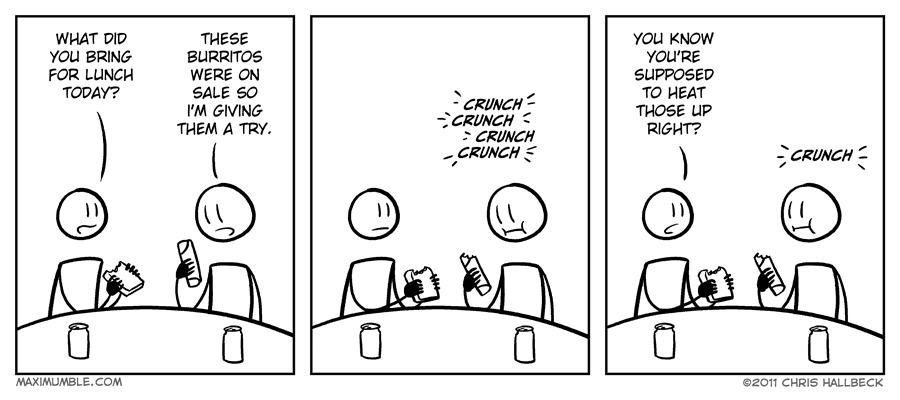
#130 – Wrap
Posted on June 3, 2011 at 12:00 am by Chris
Chapter: Comic
I remember eating frozen burritos a lot in college. They were super cheap and I actually liked them. Did they change the burrito freezing technology in the past ten years? It seems like I can never get them to cook properly anymore. There will always be a cold spot and a dried out overcooked spot. I can’t figure it out.
Tags: burrito, crunch, lunch
You were probably using a smaller, lower-powered microwave back then. If so, set your current nuker to a lower setting and see if that helps.
(Me, I ate ramen noodles in college — uncooked. So what do I know?)
Bachelor Stew: whatever was in the super sale bin, mixed together with potato flakes.
And I now I know going to college in your hometown isn’t all that bad. True desperation meant going to Mom’s or grandparents’ or uncles’, somebody would always feed me. I can see the advantages in “going away” but for food vs starving staying in town isn’t totally horrid.
The weird temperature spots are proof that photons act like a wave. If you measured the distance between hot spots, and distance between cool spots, you’d find that they would be around 12cm apart, the wavelength of the microwaves used in microwave ovens.
Science, gentlemen!
Hm, I thought it was just because microwaves have a hard time penetrating food-stuff, so it heats up the outside easily while taking “days” to heat up the inside…
Well, that an interesting way to think of it, I guess. I’m not sur I agree, since waves would move all the way through(abeit with less intensity) as it progressed, sorta like ripples. Granted, I’m not really a science person, so I may be wrong. I do know that flipping it over helps with the frozen spots in the middle.
P.S. I like your avatar.
As I learned it in culinary school, microwaves have a shallow depth of penetration (something like 1/4-1/2 inch) because they are readily absorbed by water and sugar molecules in food which is then re-emitted by those molecules as heat energy. Thus the microwaves only heat the outer layer of the food while the inner part is heated by conduction via the heat emitted by the outer layer of the food.
Its all about the flipping of the burrito half way through. Ray has a good point though, older microwaves tend to cook slower and less intense, which makes for a better, non frozen yet crispy burrito
Reminds me of Garfield and a frozen pizza. *L*
John: “Hey Garfield, What’s the only substance on earth that harder than diamond?”
Garfield (with broken teeth): “Your day-old, leftover frozen pizza.”
Should I be concerned that it’s been over ten years since I read that, yet I can still remember it word for word?
No, absolutely not, that’s just a very useful memory based trait. Hopefully you’ll be able to find a use for it in real life, if you haven’t already.
@ dirk gently you are a fool microwave wavelength is over 50 miles long
That’s not right. Even long-wave radio rarely goes far above the 3-mile range for it’s wavelengths. And that’s at 60 kHz. Household microwaves for food typically operate in the 2.45 GHz, which gives a wavelength of 12.2 cm.